Quick Takeaways
-
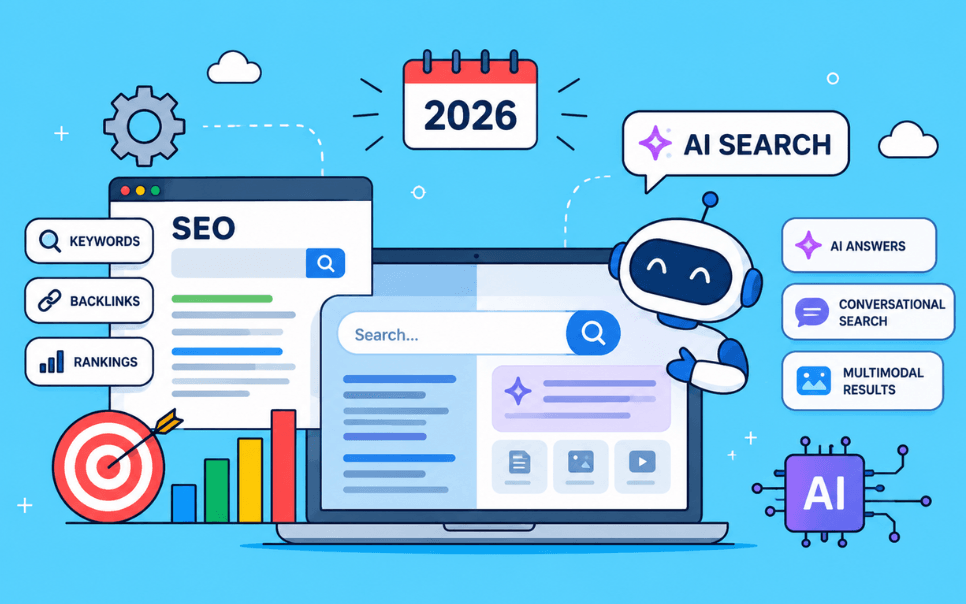
Traditional SEO will still be necessary in 2026; it won’t be the only approach to search engine visibility. It remains your starting point, but AI Overviews, ChatGPT searches, and Perplexity now respond to many queries without ever requiring a user to click through.
-
The ranking system of AI search engines places a premium on structural clarity, verifiable facts, and trustworthy entities, not keyword optimization and backlinks.
-
GEO and AEO represent your new additions over SEO, not a replacement.
-
The trend toward zero-click searches grows every day, but those searches referred by an AI engine generate more conversions and longer stays, making visibility worth it; albeit in a new way.
-
The solution lies not in reinventing the wheel, but in refactoring what you already have so it is discoverable, believable, and quote-worthy by both Google and AI engines.
For many years, SEO offered a rather straightforward concept – rank, get the click, and then convert that traffic into sales. However, in 2026, the process of search has become far more complex than that.
The client will be able to ask Google a question via AI, go through the AI Overview, evaluate different alternatives in ChatGPT or Perplexity, and create a shortlist without even clicking on any classic search result at all. If your company evaluates the performance of SEO by rankings and organic traffic alone, there is some information you might have overlooked.
And here is where the trio of AI search SEO for 2026, Answer Engine Optimization (AEO), and Generative Engine Optimization (GEO) comes into play. Instead of trying to rank for one particular keyword, the idea is to make sure that your brand is discoverable, comprehensible, believable, and worthy of mention no matter where your potential customer searches.
But does it mean that you need to give up on your old SEO in favor of this new kind of AI search SEO? Absolutely not. You just need to develop your old SEO. Let's see why.
What is AI Search and Why is Everyone Talking About It in 2026?
|
Quick Definition AI Search refers to instances where an AI search engine provides an answer directly, rather than presenting results as a list of links. Examples of AI Searches include Google AI Overviews, ChatGPT searches, and Perplexity. |
Users no longer have to type "best CRM for small business" and click on ten blue links to find their answer. They receive synthesized answers with just a few references.
The reason why this is important is that previously the search had only one gatekeeper, namely, Google's ranking algorithm. Today there are many of them, including Google's AI Overviews, Bing Copilot, ChatGPT search, and Perplexity, each making different decisions about whose quote will appear.
Based on our SEO experience for D2C and B2B businesses in India, this change affected the informational and comparative types of searches. But product and local searches are not far behind.
Why Isn’t Traditional SEO Enough Anymore in 2026?
Traditional SEO gives you the indexing and ranking. Traditional SEO doesn't ensure your brand will be selected by the AI system when writing its answer. This is another separate skill.
The practical difference looks like this:
-
Traditional SEO works with crawlers. The search bot will read your page, find the keywords, and give the page a certain position.
-
AI search works by extracting data. The AI model will read your page, find the relevant facts, and use them to write its own answer, without clicking through to your page.
If your content is written for people scrolling down the page, but not for the model that needs a clear extract to make an answer, you will rank #1 and lose visibility in AI Overviews.
In real-world scenarios, we have seen cases where even those brands with high domain authority were ignored by AI Overviews because their pages hid the answer in three paragraphs of introduction. Meanwhile, new, structurally better content was cited.
So your SEO strategy in 2026 should not be
Traditional SEO vs AI search
It should be
Traditional SEO + AI search
How Does AI Search Work?
Unlike conventional search engine ranking, AI search engines do not rank pages; instead, they identify facts, assess their credibility, and generate a new answer using multiple sources.
Here's the process in simple terms:
-
Crawl: AI robots (similar to GPTBot or PerplexityBot) go through your site as Googlebot does.
-
Chunk: In contrast to reading the whole page, the AI divides the page into several chunks.
-
Evaluate: Each chunk is evaluated in terms of clarity, factual accuracy, and the reliability of the source.
-
Synthesize: Multiple chunks from various websites are combined by the AI to form an answer.
-
Cite (occasionally): Occasionally, a few citations from sources are added – but the majority of users ignore them.
This is the reason why a site that is readable line-by-line could still struggle with this approach. If any paragraph lacks clarity without the preceding paragraph, the AI can misinterpret or even miss it altogether.
And this is how the impact of SGE on SEO works nowadays; Google's AI-powered results prioritize content that provides an answer in the first two lines of a section rather than the content building up to it.
GEO vs SEO: What’s the Real Difference?
|
Factors |
SEO(Search Engine Optimization) |
GEO(Generative Engine Optimization) |
|
Optimizes for |
Algorithms used in search engines |
AI models that generate answers |
|
Goal |
Appears at the top of search results |
Get cited or paraphrased inside the AI's answer |
|
Platforms |
Google, Bing search results |
AI Overviews, ChatGPT, Perplexity, Copilot |
|
Core unit |
The whole page/URL |
Separate chunks or parts of information |
|
Key signals |
Backlinks, keywords, page speed, domain authority |
Clarity, factual accuracy, entity trustworthiness, citations |
|
Content style |
Long-form, keyword mapped |
Self-contained, direct-answer section |
|
Sucess Metric |
Rankings, organic clicks |
AI citations, brand mentions, share of voice |
|
Timeframe to see results |
Weeks to months |
Changes can happen quickly as models recrawl the content |
How Should You Adjust Your SEO Strategy For AI Summaries & ChatGPT Searches?
1. Address the main question upfront
Do not hide the answer beneath the long intro. Answer instantly. This works for humans, featured snippets, and AI-driven search experiences.
2. Go deep on topics rather than publish random articles
Consider that you offer SEO services. Rather than having only an article about "SEO Services in India," try to have a whole content ecosystem that includes different types of topics related to SEO, such as strategy, technical SEO, local SEO, e-commerce SEO, AI search, AEO, GEO, pricing, KPIs, errors, and examples.
3. Make your brand an entity, not just a keyword
AI needs consistency in order to determine the identity of your company, what you do, who you work with, where you do it, and what you stand for. Entity optimization comes into play here.
Make sure that all company information, services offered, location, staff and author bios, contacts, and mentions are consistently presented everywhere relevant.
4. Show first-hand experience
Creating generic content is quite easy, while creating the experience is not easy at all. Use original cases, examples, insights, statistics, and learning from experiences in order to make your content better.
Do not just publish articles full of keywords; instead, create content about real customer problems that is associated with a trustworthy business.
5. Write for follow-up questions
The AI-powered search is interactive, which means that users will always want to ask a follow-up question. In your content strategy, you should consider the next step in the journey, which includes other topics, comparisons, solution-oriented content, and prices.
6. Make key information easy to find
Make the information scannable by using short paragraphs, headings, bullet points, tables, definitions, lists, FAQs, and processes.
Not only does this enhance the user experience, but it also increases the likelihood of your content being understood by both users and search engines.
7. Maintain accurate structured data
Schemas may assist search engines in comprehending the contents of the web page.
However, it is not a magic GEO button.
According to Google, there are no specific schemas needed for AI Overviews or AI Mode, and structured data must match what is visible on the page.
What are the Benefits of Combining SEO, AEO, and GEO?
Brands that excel in all three areas get visibility even without clicking – gaining awareness, credibility, and even demand.
-
You have more ways to become visible. Google rankings, AI Overviews, and chatbots- not just Google rankings.
-
You attract high-intent audiences. According to data collected by industry SEO trackers, people who are referred to websites from AI sources tend to visit more webpages and convert better compared to a regular organic audience, since they already got their question partially answered beforehand.
-
You make sure people remember your brand. Even if it is just a zero-click AI mention, your brand name becomes visible to your potential customer before the moment of decision.
-
You make your content future-proof. Good structure and clarity will serve you well both for today's Google and tomorrow's AI.
-
You don't tie yourself down to just one way of becoming visible. If your click-through rate from Google starts falling because of AI Overviews, you'll still get visibility from ChatGPT or Perplexity.
|
The statistics in a 2026 AEO/GEO analysis from Instant Press show that AI Overviews have the potential to severely lower organic click-through rates, and just 17-38% of pages referenced by AI technology are ranked in the conventional top 10 on Google. The report brings out an important transition in the search process where ranking is not sufficient; brands require content with third-party authority. |
How to Build an SEO Strategy for 2026 (Step-by-Step Guide)
A 2026-ready SEO strategy is an SEO strategy that considers technical SEO, structuring of content, and authority signals for both search engines and AI systems.
-
Check the structure of your existing content: does every part of it start answering the heading in the first two sentences?
-
Structure your content by addressing the needs of actual users, and not only by using keywords. The number of long conversational search queries is increasing.
-
Use schema markup for articles, FAQs, products, and organization to make sure the AI systems know who you are.
-
Increase your E-E-A-T rating by adding names of authors and their credentials with firsthand knowledge or data.
-
Create topic clusters, not stand-alone blog posts, to show deep knowledge of your topic.
-
Monitor your metrics, not only positions and clicks but AI referral traffic, brand mentions in AI answers, and citations.
-
Do quarterly analysis. AI-based search is changing much faster than regular algorithms; the strategy you’ve created in January can already be outdated by June.
Common Mistakes Brands Make With AI Search SEO
Don’t do these things if you want to be the source that AI will trust rather than ignore:
❌Hiding the answer. Long wind-ups before giving your actual answer.
❌Keyword stuffing. AI models recognize repetition and assume this means poor trustworthiness, not higher rankings.
❌No structure. Missing H2s, FAQ, no lists — just long paragraphs.
❌Not using data and references. Making vague statements such as “studies have shown” with no mention of which study or statistics.
❌No author identity. Content with no author’s name is difficult to verify and trust for AI models.
❌Thinking GEO is a one-time process. The search by AI models changes rapidly and requires continual updating.
❌Matching the structure of your competitors. AI models prefer something different and original.
How Bee Online Helps Businesses Build an AEO-Ready SEO Strategy
Bee Online serves as the group that will help turn this transition into reality through the auditing of your current website for SEO, fixing whatever is not being picked up by AI Search, and adding a GEO/AEO layer on top of the SEO you already have in place.
From our experience working with different brands in India and around the world, we find that most websites do not require a complete overhaul. Instead, they need:
-
Structure audit: Checking if your current page structure is answering questions in a manner that allows AI models to extract and quote the answers.
-
Fixing Schema and entities: Ensuring that Google and AI search engines can verify who you are, what you do, and that you can be trusted.
-
Content restructuring rather than rewriting: Reorganizing your current content to make sure it works well for Google, AI overviews, and chat-based searches.
-
AI traffic referral monitoring and citation frequency, along with ranking and clicks.
In practice, this is normally a question of weeks rather than months, since the content and the authority are likely already in place, just not structured for AI search.
Final Thoughts
Traditional SEO is far from dead – the problem is making it your entire strategy in 2026.
The winners of tomorrow aren't the companies with the greatest content. They are those whose websites are well-enough structured for Google and AI systems to trust, pull quotes from, and use to build authority.
|
Not sure where your brand stands today? |
Frequently Asked Questions
1. Is SEO dead in 2026?
Not really. You will still need to rely on rankings and technical SEO for visibility, but you cannot take your clicks for granted anymore since the AI Overviews are providing the answer before you can click.
2. How is AI changing search engine optimization?
The objective was transformed from "ranking the page" to "citing the fact." AI search engines analyze the text in chunks and extract the best possible pieces for inclusion in the output – thus, structure became as important as keywords.
3. What is GEO in digital marketing?
Generative Engine Optimization (GEO) is writing content in a way that AI systems such as ChatGPT, Perplexity, and AI Overviews can understand, confirm, and reference. This operates in parallel to SEO, not in place of it.
4. How do I optimize for AI search?
Answer the question at the beginning of each section in the first two lines, have proper headings and lists, support claims with actual numbers, and provide schema for AI search engines to validate your brand.
5. Will AI replace Google search?
Not entirely. Google already uses its AI Overviews on its own results page. The only realistic transition will be between several search interfaces existing alongside each other, not one replacing another.